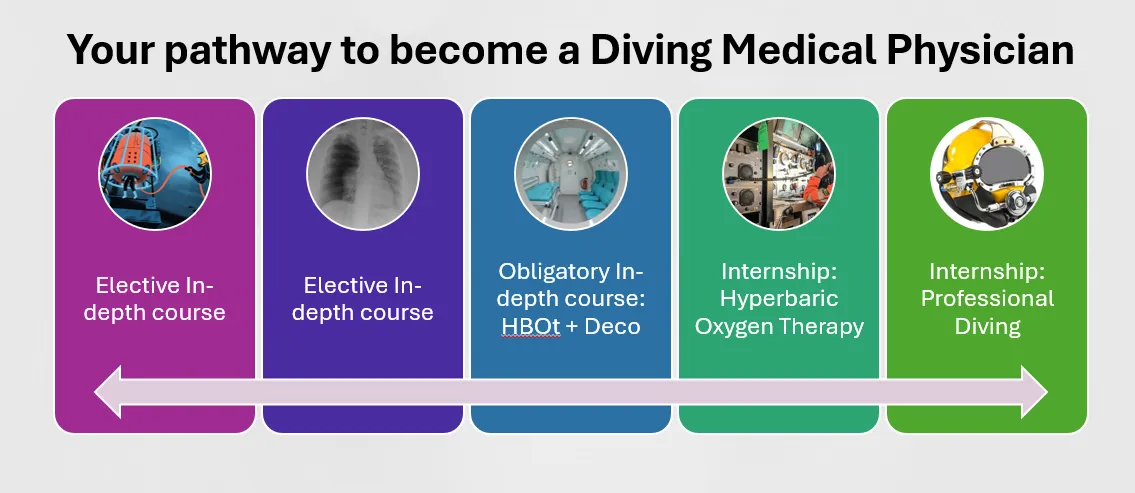
The Scott Haldane Foundation offers a structured series of advanced level diving medicine courses that together form a complete training pathway in diving medicine.
By successfully completing all five required In-depth SHF courses and internships, participants qualify as:
Diving Medicine Physician (DMP) in accordance with internationally recognised ECHM/EDTC standards.
Participation in Advanced Level courses is open to those who have successfully completed the SHF Physiology & Pathology of Diving & Hyperbaric Exposure course, or an equivalent qualification.
Certification is possible for those certified as Medical Examiner of Divers course and requires successful participation in the mandatory in-depth course, two elective in-depth courses, and two internships.
All in-depth or advanced-level courses provide Continuing Medical Education (CME) credits and contribute to the recertification of diving physicians, including D/Associated Specialists (Dutch system), MED, and DMPs.
In depth courses are designed to include all mandatory components required for DMP certification.
In addition, each course features a distinct thematic focus, ensuring fresh and relevant content for already certified DMPs as well as those attending for recertification or continuing medical education (CME).
Examples of courses are:
Each year at least 2 elective In-Depth Courses are organised (one in the Netherlands and one abroad)
This module introduces the principles and clinical practice of hyperbaric oxygen therapy.
Participants will learn about different chamber types, their operation, and applicable European regulations and safety systems.
The course covers evidence-based indications for HBO, including mandatory, recommended, and experimental uses, with reference to current European guidelines. It also addresses patient management, including preparation, monitoring, communication, and recognition of complications.
In addition, key aspects of device use, data interpretation, and risk and safety management are presented, ensuring a solid foundation for safe and effective clinical practice.
This internship is a mandatory component of the training and is intended for participants who have completed the corresponding theoretical course.
During the internship, participants apply previously acquired knowledge in a clinical hyperbaric setting. The focus is on observing and participating in routine operations, patient management, chamber procedures, and safety protocols.
This supervised internship provides practical exposure to diving medicine in a commercial diving or naval operational setting.
Participants gain insight into commercial diving or military diving procedures, including the application of dive tables and real-world diving operations.
The programme includes facility and vessel visits, as well as case-based discussions and focused sessions on key clinical topics relevant to diving practice.
Designed to complement prior theoretical training, this internship emphasizes observation and application within a professional environment.